
There are a few different ways you can construct an index of stocks.
One approach—the most common method—is market-cap weighting, also known as cap-weighted. This gives the largest companies a bigger influence on performance, meaning their returns carry the most weight in the overall index.
Another approach is to simply weigh every company equally, regardless of size. We call this equal-weighted.
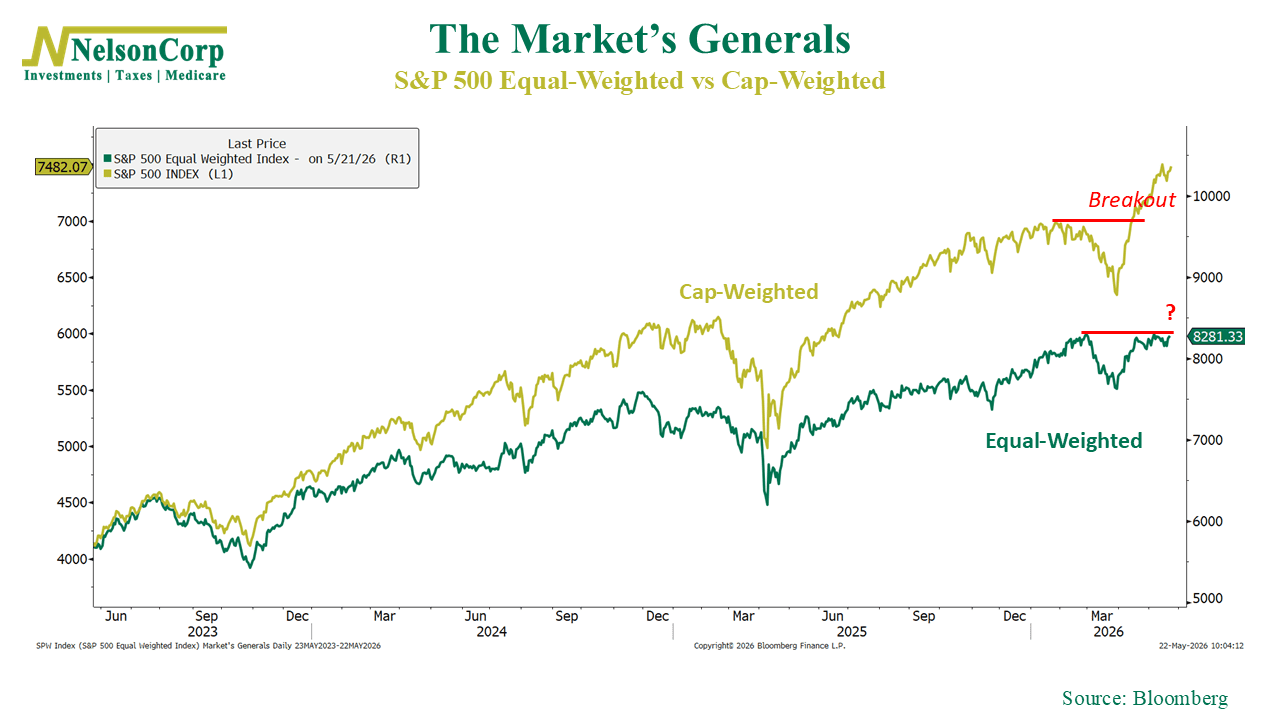
On the chart above, we compare these two methodologies using the S&P 500 Index. The gold line is the traditional cap-weighted S&P 500 Index. The green line is the less common, but still very important, equal-weighted version.
As you can see, the cap-weighted index broke out to fresh all-time highs roughly a month ago. But the equal-weighted version has yet to confirm the breakout, although it’s getting close.
Why does that matter? Because a breakout in the equal-weighted index would suggest improving market participation beneath the surface. Leadership would be expanding beyond the handful of mega-cap “market generals” that dominate the cap-weighted index.
The soldiers, so to speak, would be joining the fight.
Think of this as a test of the market’s foundation. A rally led by only a few mega-cap stocks can still push indexes higher, but it leaves very little room for error if those leaders stumble. A breakout in the equal-weighted index would be good to see here.
This is intended for informational purposes only and should not be used as the primary basis for an investment decision. Consult an advisor for your personal situation.
Indices mentioned are unmanaged, do not incur fees, and cannot be invested into directly.
Past performance does not guarantee future results.
The S&P 500 Index, or Standard & Poor’s 500 Index, is a market-capitalization-weighted index of 500 leading publicly traded companies in the U.S.
The S&P 500 Equal Weight Index is an equal-weighted version of the S&P 500 Index in which each of the 500 constituent companies is assigned the same weight, regardless of market capitalization.