
Speculation. Is it good or bad for the stock market?
Sometimes, it can be good. It’s a sign of optimism. But, as we know, too much of a good thing can be bad. So how do we know we’ve reached that point?
Well, that’s what this week’s indicator—the NDR Speculation Index—attempts to answer. It measures how aggressively investors are positioning themselves through exchange-traded funds (ETFs). Specifically, it compares assets flowing into leveraged long U.S. equity ETFs versus inverse equity ETFs. Basically, it’s measuring whether investors are betting heavily on stocks continuing to rise or seeking protection against a decline.
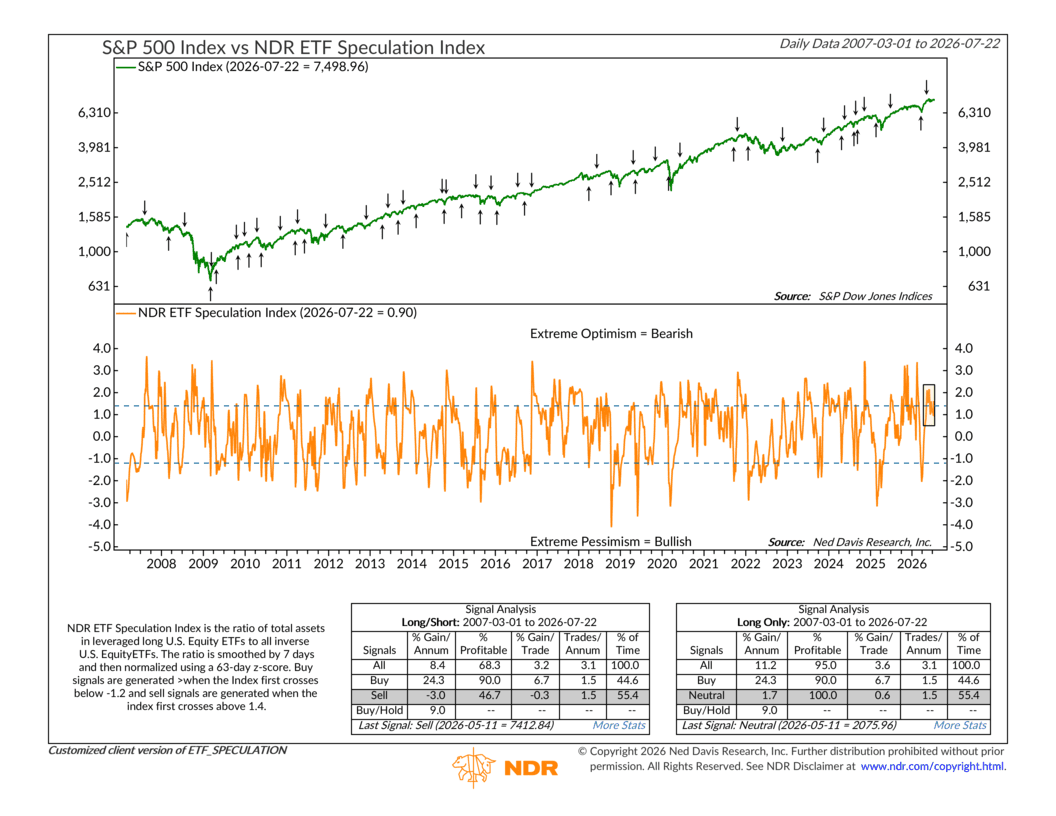
The orange line in the bottom panel is normalized so that readings above roughly 1.4 signal unusually high optimism, while readings below -1.2 reflect extreme pessimism.
Historically, this has worked best as a contrarian signal. Excessive optimism often appears after markets have already rallied significantly, leaving investors vulnerable to disappointment. Extreme pessimism, on the other hand, frequently shows up near important market lows when much of the bad news has already been priced in.
That relationship is illustrated in the top panel. The arrows mark historical buy and sell signals generated by the indicator. Since 2007, buying during periods of extreme pessimism has produced an annualized return of roughly 24%, with 90% of those trades ending profitably. Periods of extreme optimism, on the other hand, have generated hypothetical losses on average.
Today, the indicator is hovering near the optimism threshold. As you can see, it actually moved above that level back in May. Since that hypothetical sell signal, the S&P 500 has largely traded sideways and is actually down about 0.4%.
In other words, according to this indicator, investor speculation has remained elevated for several months, and historically, those periods have tended to produce below-average returns until some of that optimism is worked off.
Now, as always, we believe it’s best to avoid relying on any single indicator. The ETF Speculation Index is simply one piece of the broader weight of the evidence. Right now, the message is fairly straightforward: speculation is elevated. That doesn’t tell us exactly when the market will turn, but it does suggest future returns may be more difficult to come by.
This is intended for informational purposes only and should not be used as the primary basis for an investment decision. Consult an advisor for your personal situation.
Indices mentioned are unmanaged, do not incur fees, and cannot be invested into directly.
Past performance does not guarantee future results.
The S&P 500 Index, or Standard & Poor’s 500 Index, is a market-capitalization-weighted index of 500 leading publicly traded companies in the U.S.