
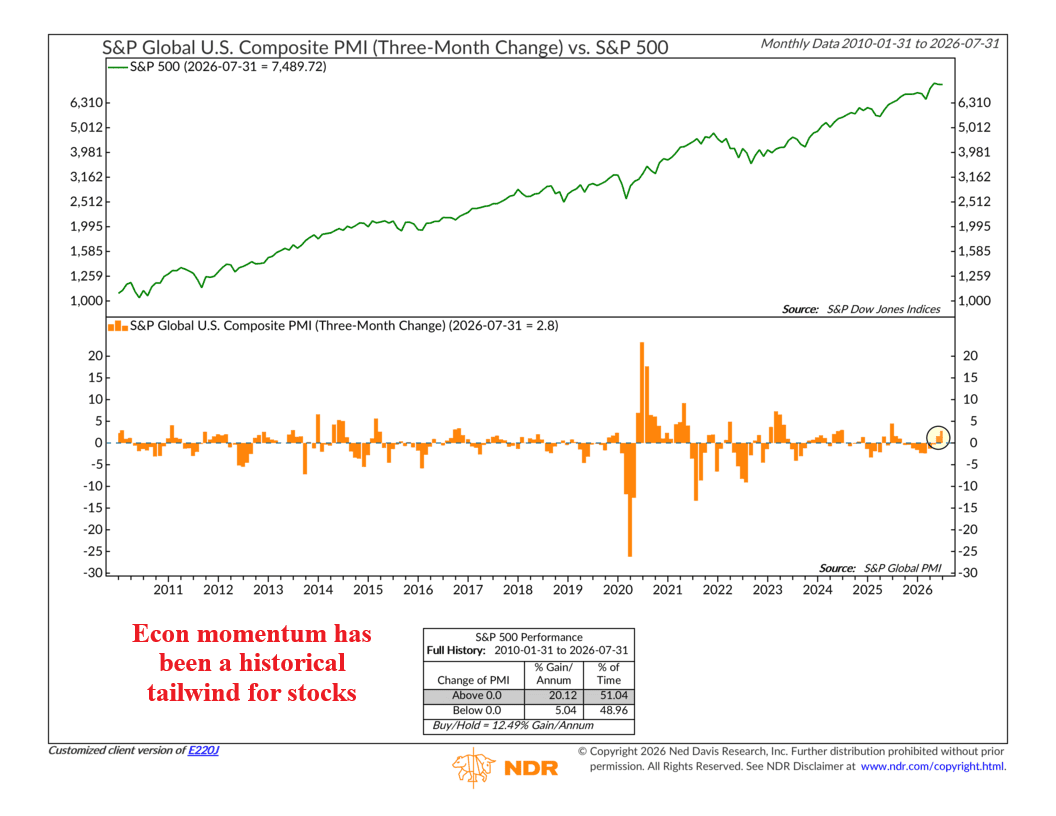
The stock market is not the economy. This is true. The two don’t always move together, especially in the short run. But we do find evidence that a strengthening economy can provide an important tailwind for stocks when conditions are right.
When are conditions right? Well, this week’s indicator provides an answer. It looks at the 3-month change (the momentum) in the S&P Global U.S. Composite PMI. This is essentially a Purchasing Managers Index that surveys businesses across both the manufacturing and service sectors to gauge whether economic activity is improving or weakening.
In other words, this indicator focuses on the direction of economic momentum. Is business activity getting better or worse compared to a few months ago?
As you can see, right now, it’s getting better. The 3-month change in the Composite PMI rose to +2.8 in July, its strongest reading in over a year.
This is important because, historically, that has coincided with strong returns for the stock market. Since 2010, when the 3-month change in the PMI has been above zero, the S&P 500 stock index has gained an average of 20.1% per year. In contrast, when PMI momentum has been negative, that return has dropped to just 5.0% per year.
Now, that all makes sense when you think about it. A strong—or rather, an improving—economy helps support sales and earnings, which gives businesses more confidence to invest and expand. Remember, the stock market is forward-looking, so an economy that is gaining momentum can often be more important than one that is simply strong.
Of course, positive PMI momentum does not guarantee that stocks will continue higher. But with the latest reading firmly above zero and moving in the right direction, it’s hard to argue with the fact that the economic backdrop is currently providing another tailwind for the equity market.
Bottom line: Economic momentum is improving, and history suggests that has been a favorable environment for stocks. For now, the PMI remains an equity tailwind.
This is intended for informational purposes only and should not be used as the primary basis for an investment decision. Consult an advisor for your personal situation.
Indices mentioned are unmanaged, do not incur fees, and cannot be invested into directly.
Past performance does not guarantee future results.
The S&P 500 Index, or Standard & Poor’s 500 Index, is a market-capitalization-weighted index of 500 leading publicly traded companies in the U.S.