
How old is too old for a bull market?
It’s something you naturally start asking after stocks have been rising for a while. Surely the stock market can’t just keep going up forever, right? Eventually, a downturn must be right around the corner.
Well, we dug into some history this week, and I think this week’s chart provides some helpful perspective.
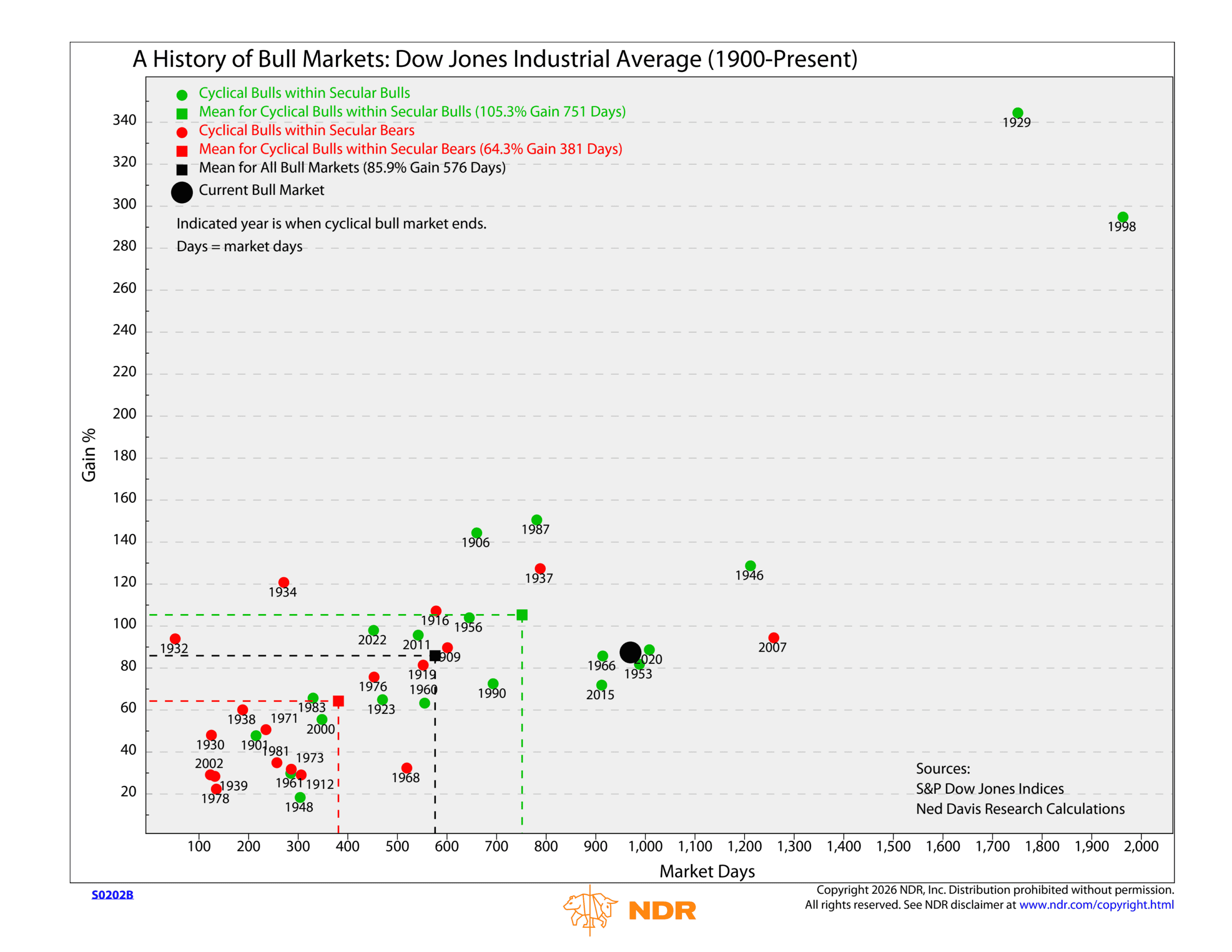
The chart above plots every bull market for the Dow Jones Industrial Average going back to 1900. The horizontal axis shows how long each bull market lasted, measured in market days, while the vertical axis shows the total gain. The large black dot represents the current bull market.
Historically, the average bull market has lasted 576 market days and gained about 86%. The current bull market has already lasted close to 1,000 market days, with a gain of roughly 85%.
So, is it getting old? Compared to the average, sure, absolutely. But that doesn’t necessarily mean it’s nearing the end.
History shows there has been enormous variation in both the length and strength of bull markets. Several have lasted more than 1,000 market days, while some of the strongest have produced gains of 200%, 300%, or more.
The chart also separates bull markets based on the longer-term market environment. Bull markets occurring within secular, or long-term, bull markets have historically been stronger, averaging a 105% gain over 751 market days. Those occurring within secular bear markets have averaged a much smaller 64% gain over just 381 market days.
So, I think the real lesson, according to the data, is that bull markets don’t come with expiration dates. A market can be older than average, expensive, or sitting near record highs and still continue climbing for quite some time.
Eventually, though, yeah, every bull market ends. But history suggests that age alone usually isn’t what kills it.
The bottom line? The current bull market is certainly mature by historical standards, but “older than average” doesn’t mean “over.” Rather than trying to predict an expiration date, investors are better served by watching the economic, fundamental, and technical evidence that ultimately determines whether a bull market still has room to run.
This is intended for informational purposes only and should not be used as the primary basis for an investment decision. Consult an advisor for your personal situation.
Indices mentioned are unmanaged, do not incur fees, and cannot be invested into directly.
Past performance does not guarantee future results.
The Dow Jones Industrial Average (DJIA) is a price-weighted index composed of 30 widely traded blue-chip U.S. common stocks.