
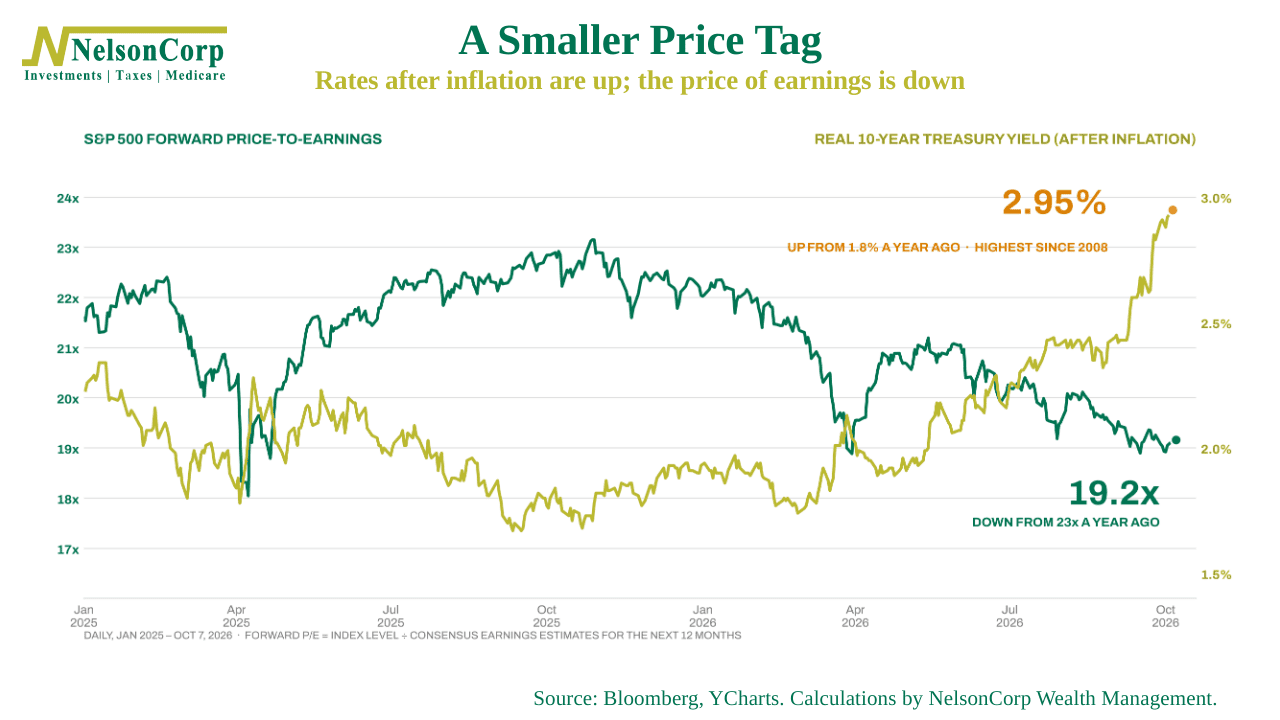
With the stock market sitting right around a record high, it might look like stocks have shrugged off this year’s jump in interest rates. They haven’t. Higher rates have definitely left a mark. You just have to know where to look.
Let me walk you through the chart. The green line shows how much investors are paying for every dollar of profit that the companies in the S&P 500 stock index are expected to earn over the next year. Think of it as a price tag. A year ago, that price tag was about 23 dollars for every dollar of profit. Today it’s about 19.
The olive line shows what a 10-year Treasury bond pays after inflation is taken out. A year ago, that was under 2%. Now it’s close to 3%, the highest it has been since 2008.
You can see how the two lines move in opposite directions. That’s no accident. When a safe government bond pays almost 3% after inflation, investors don’t have to pay up for stocks to get a decent return. So they don’t. The price tag on stocks just comes down.
In other words, higher rates have still put a dent in the market this year, but you can’t really see it, because profits have just covered it up.
How? Well, company earnings are up about 33% over the past year. Bigger profits with a smaller price tag can still add up to a higher stock market.
So, the bottom line? Stocks, in fact, haven’t been immune to higher rates. Investors are paying roughly 16% less for a dollar of profit than they were a year ago. The market is higher anyway because companies are just earning a lot more.
Earnings season starts next week. So, we’ll find out whether the profits keep coming.
This is intended for informational purposes only and should not be used as the primary basis for an investment decision. Consult an advisor for your personal situation.
Indices mentioned are unmanaged, do not incur fees, and cannot be invested into directly.
Past performance does not guarantee future results.
The S&P 500 Index, or Standard & Poor’s 500 Index, is a market-capitalization-weighted index of 500 leading publicly traded companies in the U.S.