
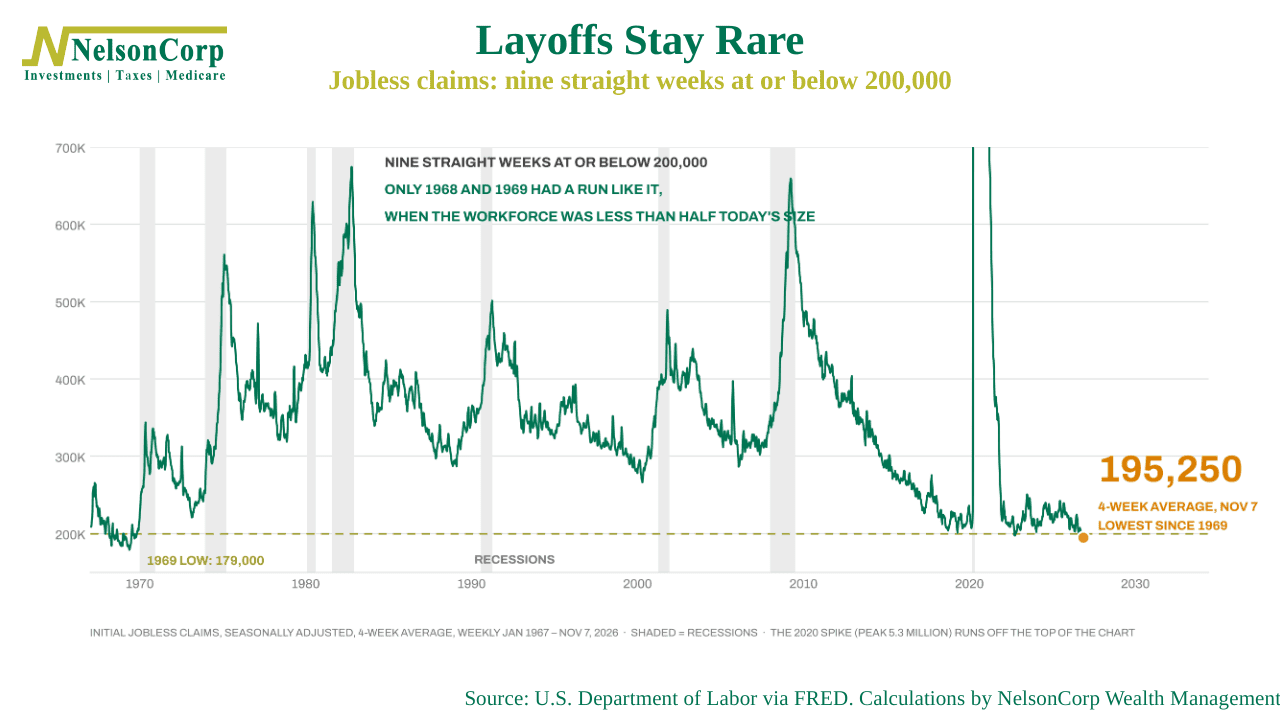
This week’s chart might come as a surprise for some—or, at least, it doesn’t really fit the mood right now. It has to do with layoffs.
To set the stage, inflation came in hot again last Tuesday, the Fed is openly talking about a bigger rate hike in December, and bond yields remain volatile. So, you’d think companies would be starting to cut jobs by now, right?
Well, they aren’t. Not really, anyway.
The chart above shows weekly claims for unemployment benefits going back to 1967. When somebody loses a job, they file a claim that same week, so this is about the closest thing we have to a live count of layoffs.
What’s crazy is that for nine straight weeks now, claims have come in at or below 200,000. The four-week average is 195,250, the lowest reading since 1969. And here’s the part that’s really shocking: back in 1969, the workforce was less than half the size it is today. Relative to the number of people working, layoffs have rarely been this scarce.
So what does it mean? Two things. First, the job market is holding up, and that’s good news for anybody with a paycheck. Second, it’s exactly why the Fed feels free to keep raising rates. If layoffs were climbing, the Fed would have to choose between fighting inflation and protecting jobs. Right now it doesn’t have to choose. Higher rates are clearly biting in some places (home sales just fell to a 16-year low), but not here.
Now, here’s the catch. Look at the gray bars on the chart. Those are recessions, and going into every one of them except 2020, this layoffs line was already heading up. Layoffs are one of the first places trouble shows up; in the econ world, we call that a “leading indicator.”
But there’s a problem. It can change quickly. For example, claims hit their all-time low in May of 1969, and a recession started seven months later. In other words, a low reading says a lot about today, but that doesn’t always translate smoothly into next year.
The bottom line? Layoffs are about as rare as they get right now, and that’s a big reason why the economy has shrugged off higher rates so far. It’s one piece of the evidence, sure, but right now it’s a good piece. The thing to watch is the turn. If this line starts climbing while the Fed is still raising rates, that’s when the story could change.
This is intended for informational purposes only and should not be used as the primary basis for an investment decision. Consult an advisor for your personal situation.
Indices mentioned are unmanaged, do not incur fees, and cannot be invested into directly.
Past performance does not guarantee future results.