
Go with the crowd until it reaches an extreme, and then do the opposite. This rejection of popular opinion at extremes is how we think about contrarian investing. There are many ways to do this, and we incorporate several of these into our analysis of risk. But today, I want to focus specifically on stock market volatility.
To do this, we look at the CBOE Volatility Index, or simply “the VIX.” The VIX combines the implied volatilities from options (puts and calls) on the S&P 500 index with an average time to maturity of 30 days into a measure of stock market volatility. A higher VIX reading indicates that investors are willing to pay more for S&P 500 index options. This is based on their expectations of future volatility and tends to occur during market declines as fear takes over. In contrast, lower readings are associated with a flat or rising market, when traders tend to be more complacent.
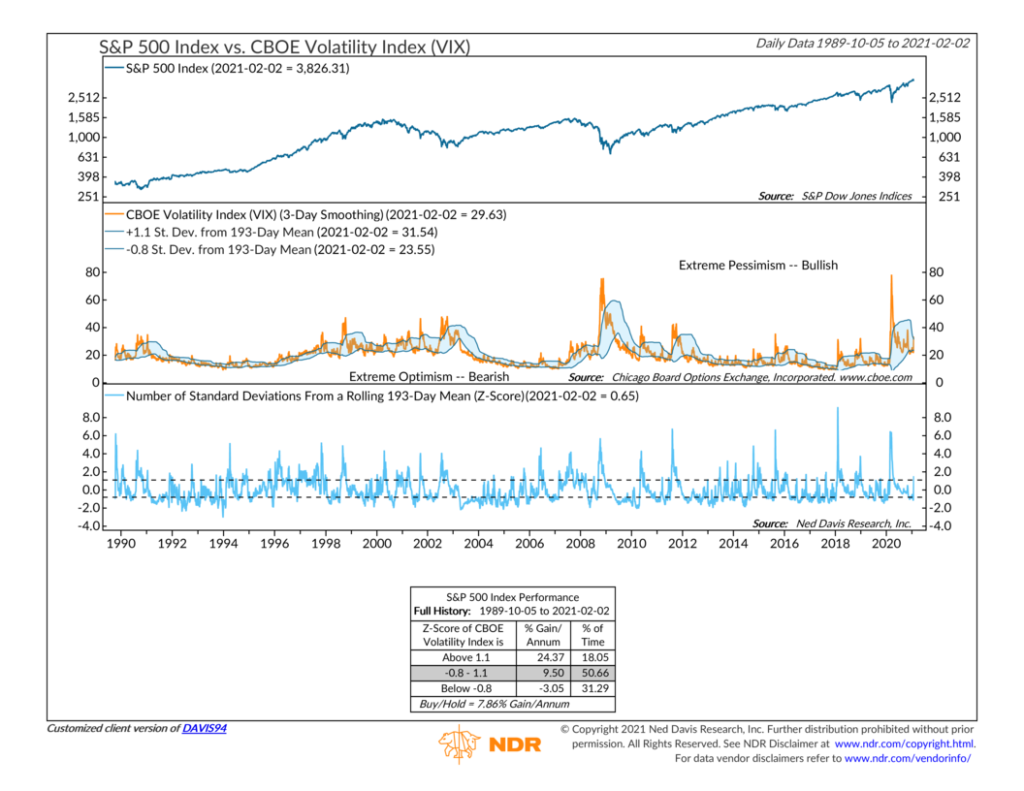
These features make the VIX a useful sentiment indicator. The chart above takes the VIX index (smoothed by three days) and plots standard deviation brackets around it. Historically, when the VIX has spiked above the upper standard deviation line, it indicates that the crowd has become way too pessimistic. The VIX tends to mean revert, meaning that it falls back to normal levels after a large spike. This is a bullish environment for stocks, as evidenced by the stellar 24.37% average return of the S&P 500 while the VIX is above its upper standard deviation line.
On the other hand, when the VIX has fallen below the lower standard deviation line, it’s a sign that investors are way too optimistic. From here, it doesn’t take much to spook the crowd into a sell-off. Historically, this has equated to a -3.05% average return for the S&P 500.
For our purposes of managing risk, the goal is to be wary of crowd psychology at extremes. This indicator does a nice job of accomplishing just that by measuring when optimism or pessimism has gotten carried away.
This is intended for informational purposes only and should not be used as the primary basis for an investment decision. Consult an advisor for your personal situation.
Indices mentioned are unmanaged, do not incur fees, and cannot be invested into directly.
Past performance does not guarantee future results.