
For the past few years, stocks have really done a lot of the work in most portfolios. Sure, it’s been comfortable. But it has also changed what those portfolios look like.
This week’s featured chart highlights what I mean.
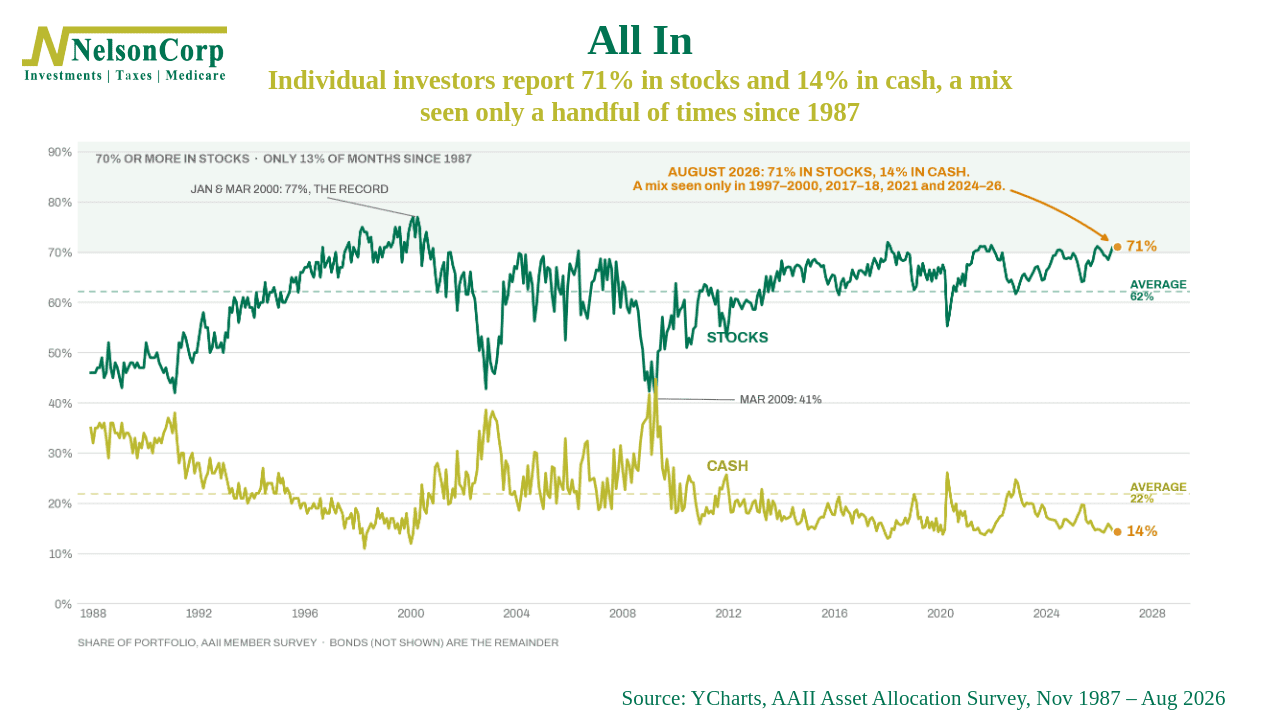
Every month, the American Association of Individual Investors asks its members how their money is split between stocks, bonds, and cash. The chart above shows the answers going back to 1987. The dark green line is stocks. The lighter olive line is cash.
As of August, individual investors report 71% in stocks and just 14% in cash. Over the full history, the averages are 62% and 22%. Stock allocations have been this high in only about one month out of eight, and nearly all of those came in a few distinct stretches: 1997 to 2000, 2017 to 2018, 2021, and the past two years.
Large institutional investors are in the same boat. One widely followed measure of their stock allocations has matched its previous high from early 2007.
Now, part of this is enthusiasm, and part is arithmetic. Stocks have roughly doubled since the start of 2023, while bonds have gained only modestly. Even investors who never made a change now hold a bigger share in stocks than they did three years ago.
Why does that matter? Think of investor positioning as a measure of how much buying power is left on the sidelines. When most of the money is already in stocks, and cash is near the low end of its history, there is less fuel available to push prices higher. New money has to come from somewhere.
Therefore, history suggests some caution here. The earlier stretches of 70%-plus readings were each followed by a rough patch: the 2000–02 bear market, the late-2018 correction, and the 2022 bear market. But not always. Readings above 70% in mid-2024 were followed by another strong year. So heavy positioning is a poor timing tool, but still a fair guide to how little room for error the market has.
It also helps to remember that this is one measure among many. Positioning is one of the sentiment readings that feed into how we set stock exposure, and it never acts alone. Other things we follow, like the market’s trend and the growth in corporate earnings, still lean positive.
The bottom line? Crowded positioning argues for realistic expectations more than anything else.
This is intended for informational purposes only and should not be used as the primary basis for an investment decision. Consult an advisor for your personal situation.
Indices mentioned are unmanaged, do not incur fees, and cannot be invested into directly.
Past performance does not guarantee future results.