
There’s no doubt about it; artificial intelligence has been a big driver of this bull market. Investors just can’t stop pouring money into semiconductor companies, making big bets on the AI revolution. That enthusiasm has helped push many chip stocks to extraordinary heights over the past several years.
But when does strong performance become too much of a good thing?
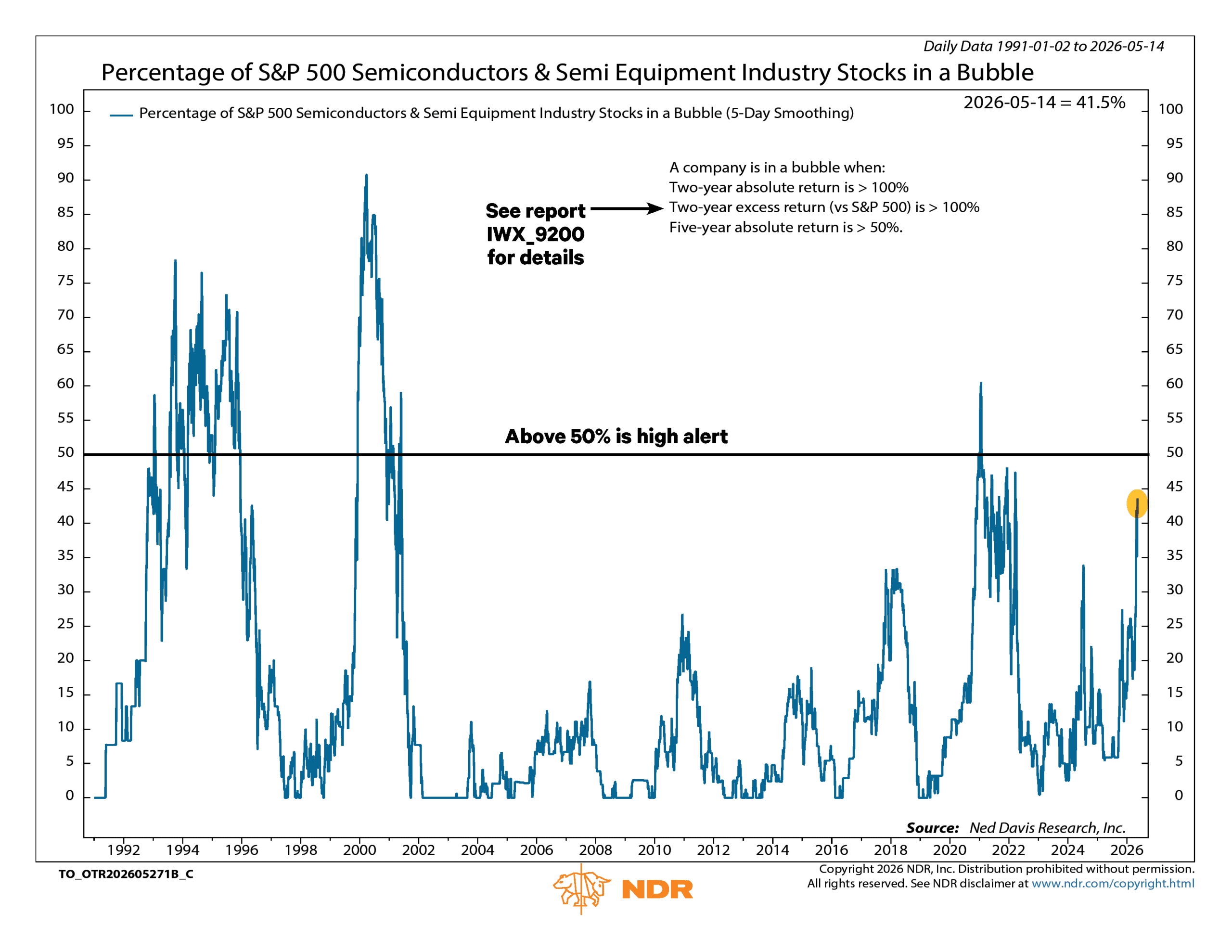
Our featured chart this week tracks the percentage of semiconductor and semiconductor equipment companies in the S&P 500 that meet our predefined definition of a “bubble.” To qualify, a stock must have gained more than 100% over the previous two years, outperformed the S&P 500 by more than 100 percentage points over that same period, and posted a five-year gain of at least 50%.
Historically, readings above 50% have been a warning sign. During the technology bubble of the late 1990s, more than half of semiconductor stocks met these criteria before the eventual collapse. Similar spikes occurred during other periods of speculative enthusiasm.
Today, the indicator stands at 41.5%. That’s elevated relative to most of history, but still below the 50% “high alert” threshold shown on the chart. In other words, there are signs of froth in the semiconductor industry, but the sector has not yet reached the extremes seen during past major bubbles.
It’s also worth noting that today’s environment differs from the dot-com era in one important respect. Many of the companies leading the AI boom are highly profitable businesses with strong cash flows and real demand for their products. While valuations may be stretched in some cases, this isn’t simply a story of speculative companies with no earnings.
That said, history suggests investors should pay attention when a growing percentage of stocks in a single industry begin exhibiting bubble-like characteristics. The higher the reading climbs, the more dependent future returns become on continued optimism and perfect execution.
Bottom Line: The semiconductor industry remains one of the market’s strongest areas, supported by the ongoing AI buildout. However, with more than 40% of semiconductor stocks now meeting our bubble criteria, investors should recognize that expectations have become increasingly lofty. The trend is not yet in the danger zone, but it’s getting close enough to warrant attention.
This is intended for informational purposes only and should not be used as the primary basis for an investment decision. Consult an advisor for your personal situation.
Indices mentioned are unmanaged, do not incur fees, and cannot be invested into directly.
Past performance does not guarantee future results.