
It’s been a rough stretch for the bond market lately. Long-term Treasury yields are pushing higher. The 30-year yield has climbed above 5% and recently reached levels not seen in nearly two decades.
For bond investors, this can feel pretty painful. Bond prices and yields move in opposite directions, so when yields rise, the value of existing bonds generally falls.
But there is another side to higher yields that is easy to overlook: they also improve the starting point for future returns.
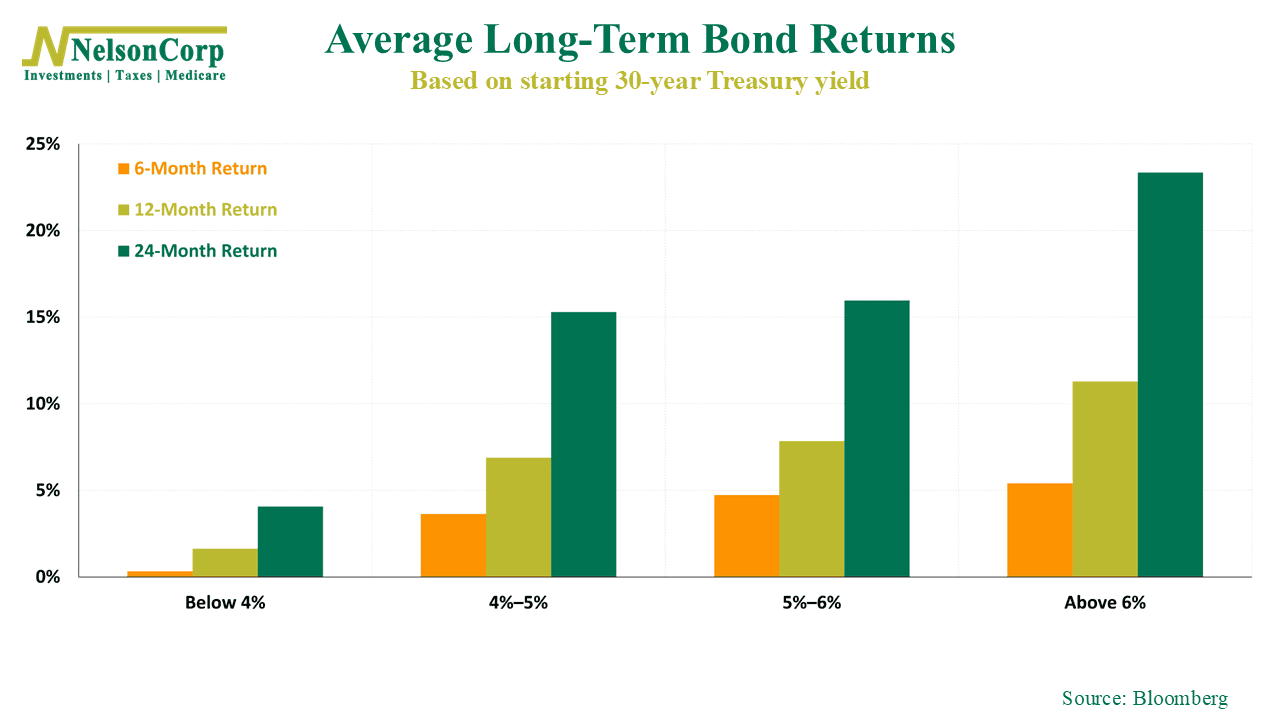
The chart above looks at monthly 30-year Treasury yields going back to 1977 and groups them into four different starting-yield ranges. It then shows how long-term U.S. Treasury bonds performed over the following 6, 12 and 24 months.
The relationship, as you can see, is fairly straightforward.
When the 30-year Treasury yield started below 4%, long-term Treasuries produced an average return of just 1.6% over the following year and 4.1% over the following two years.
As starting yields increased, so did subsequent returns.
With the 30-year yield between 5% and 6%, which is roughly where we find ourselves today, long-term Treasuries historically returned an average of 4.7% over the next six months, 7.8% over the next year and 16.0% over the next two years.
And when yields started above 6%, those average returns climbed even further, reaching 11.3% after one year and 23.3% after two years.
There are no guarantees that history will repeat itself, of course. Yields could continue rising from here, which would put additional pressure on bond prices in the near term.
Still, the historical relationship highlights an important point. Higher interest rates may be uncomfortable while they are rising, but they also mean investors are being paid more to own bonds going forward.
That matters beyond the bond market itself. For investors who own a diversified portfolio of stocks and bonds, higher starting yields give the bond side of the portfolio more potential to contribute to returns. They also provide more income and a larger cushion against future increases in rates.
And if the economy eventually weakens and interest rates fall, bonds could once again provide an important source of diversification when stocks are under pressure.
So while rising yields have created plenty of frustration for bond investors, they have also improved the potential role bonds can play in a balanced portfolio.
Bottom line: What has made bonds painful on the way here may ultimately make them more useful going forward.
This is intended for informational purposes only and should not be used as the primary basis for an investment decision. Consult an advisor for your personal situation.
Indices mentioned are unmanaged, do not incur fees, and cannot be invested into directly.
Past performance does not guarantee future results.
The Barclays Long-Term Treasury Bond Price Index is a market-value-weighted index that tracks the price performance of U.S. Treasury securities with long-term maturities, excluding the impact of interest income and coupon reinvestment.