
Will the Fed raise interest rates this month?
It’s the big question on Wall Street right now. The Fed cut rates three times last fall and has held steady ever since. But this morning’s jobs report came in much stronger than expected, and the odds of a rate hike at the Fed’s September 16th meeting are now roughly a coin flip.
Here’s the thing, though: the bond market has already voted.
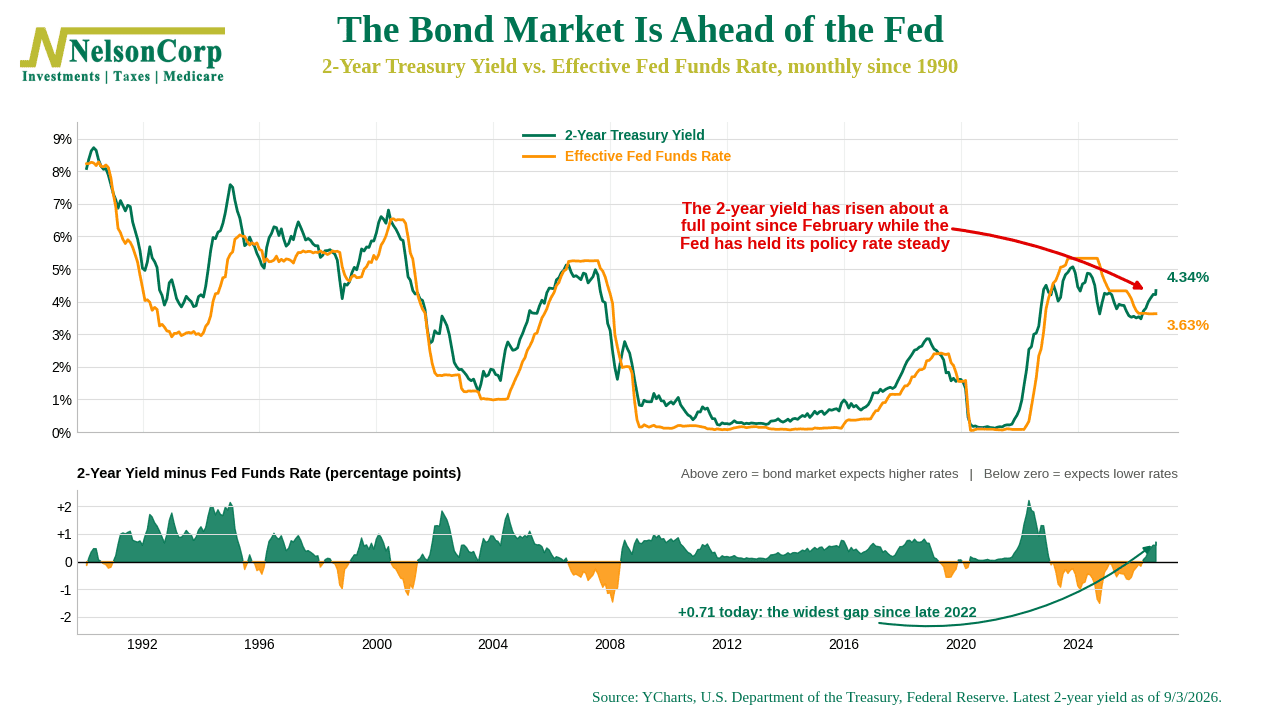
The chart above compares two interest rates. The orange line is the rate the Fed sets. The green line is the yield on the 2-year Treasury, which is set by investors. Think of it as the bond market’s forecast of where the Fed is headed over the next couple of years.
The bottom panel shows the gap between the two. Above zero, investors expect higher rates. Below zero, they expect cuts.
Notice how the green line tends to move first. It climbed ahead of Fed rate hikes in 1994, 1999, 2004, 2015, and 2022, and it fell ahead of rate cuts in 2001, 2007, 2019, and 2024. The Fed doesn’t always follow the bond market, but it usually does—eventually.
Today, the 2-year yield is up nearly a full point since February, while the Fed hasn’t moved. The gap between the two is now the widest since late 2022, the last time the Fed was raising rates.
The bottom line? Whatever the Fed decides on September 16th, the bond market has already done much of the tightening for it. If a hike comes, it won’t be the Fed leading the market. It will be the Fed catching up.
This is intended for informational purposes only and should not be used as the primary basis for an investment decision. Consult an advisor for your personal situation.
Indices mentioned are unmanaged, do not incur fees, and cannot be invested into directly.
Past performance does not guarantee future results.