
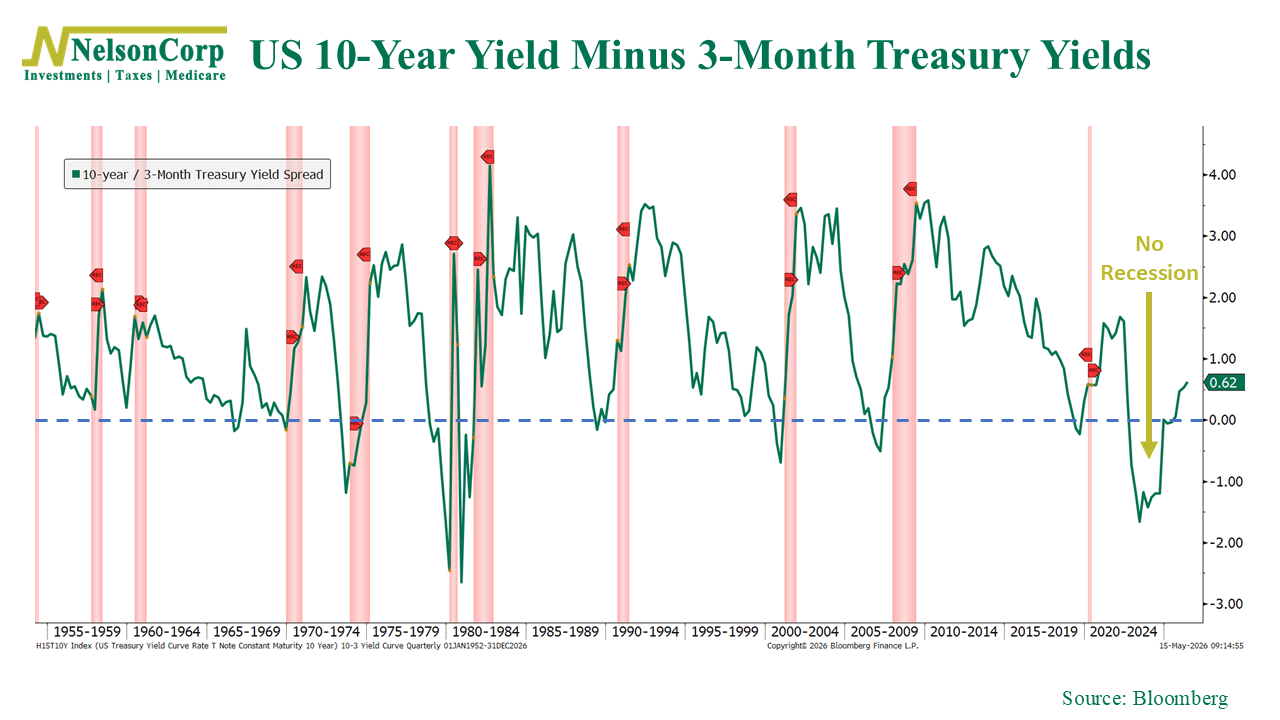
For decades, the yield curve has been one of Wall Street’s favorite recession warning signs. Specifically, I’m talking about the difference between 10-year and 3-month U.S. Treasury yields. When short-term rates rise above long-term rates, the curve “inverts,” and that has historically been a strong signal that a recession may be coming. In fact, it correctly warned of every recession going back to 1989.
Then came 2022.
The yield curve inverted to its deepest level since 1985, at one point more than 100 basis points negative. By historical standards, a recession should have followed soon after. But it never came. The economy kept growing, consumers kept spending, and the job market stayed surprisingly strong.
So what happened? In past cycles, the inversion was usually followed by a major problem, like the dot-com crash, the financial crisis, or the pandemic. This time, that catalyst never really showed up. The economy simply proved more resilient than many expected.
Now the yield curve has finally un-inverted. The 10-year Treasury yield sits above the 3-month yield again, about 4.47% versus 3.69%. That’s generally seen as a healthy sign because it suggests investors are less worried about an immediate recession.
But there’s an important catch. Historically, the move back to a normal yield curve has not always been great for stocks in the short term. In our data, markets have sometimes struggled after a dis-inversion, partly because investors start expecting slower growth or Federal Reserve rate cuts.
The bottom line? The economy has held up far better than many expected, and that’s encouraging. But even though the yield curve looks healthier today, history suggests investors should still stay balanced and cautious rather than assuming the risks are completely gone.
This is intended for informational purposes only and should not be used as the primary basis for an investment decision. Consult an advisor for your personal situation.
Indices mentioned are unmanaged, do not incur fees, and cannot be invested into directly.
Past performance does not guarantee future results.