
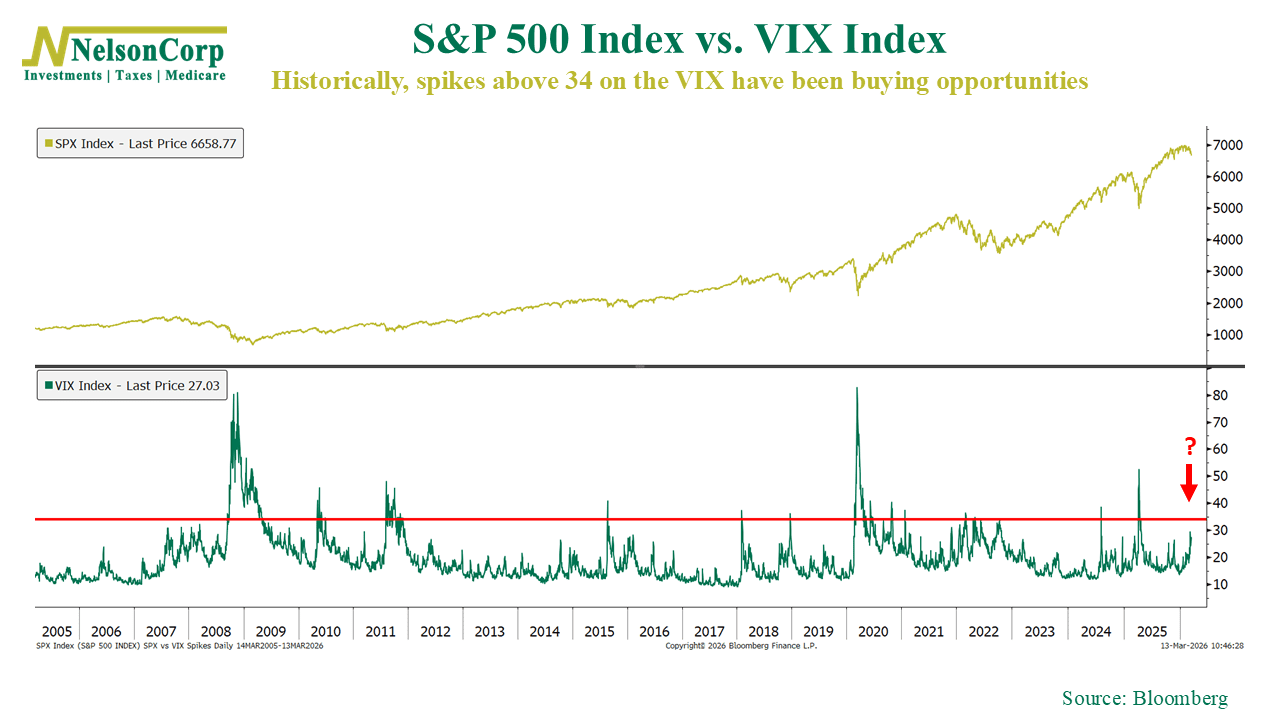
When markets come under pressure like they have in recent weeks, I always find it helpful to consult what we call the “VIX Playbook.”
It’s based on the CBOE Volatility Index, or what you might have heard referred to as Wall Street’s “Fear Gauge.” It measures expected volatility in the S&P 500 Index based on options prices. Typically, when investors get nervous, they rush to buy protection, and that tends to push the VIX higher.
The idea behind the VIX Playbook is that big spikes in the VIX can signal when investors are capitulating. Think of it like a wide receiver signaling the quarterback that he’s wide open for a touchdown. More often than not, if you follow the signal, you’ll be rewarded.
So how does it work? Well, the chart highlights the most important level on the VIX: 34. Why is this important? Because it’s roughly two standard deviations above the index’s long-term average. Readings that high tend to happen after extreme levels of market stress and capitulation-like selling.
That’s the signal we’re looking for. Historically, once the VIX spikes above 34 (or even higher), the S&P 500 Index has tended to bottom fairly soon afterward. Looking back over the past two decades, most surges above that level occurred during sharp corrections or crisis events, including 2008 and the 2020 pandemic shock. In many cases, stocks were already deep into a selloff by the time volatility reached those extremes.
Now, to be fair, it’s not perfect. Sometimes, like in 2022, the VIX needed to reach that level several times before the market finally bottomed. That’s something to keep in mind, and it’s also why we prefer a weight-of-the-evidence approach rather than relying on any single indicator
Ok, then, so why does this all matter today?
Well, currently we’re in the midst of a modest sell-off in the stock market. The VIX has started to rise, but as of this writing, it’s still between 20-30, which has historically been elevated volatility but not necessarily the all-out capitulation we’d want to see during a prolonged downturn.
In other words, investors are clearly getting nervous, but we haven’t yet seen the kind of fear spike that has historically marked the most attractive buying opportunities.
This is intended for informational purposes only and should not be used as the primary basis for an investment decision. Consult an advisor for your personal situation.
Indices mentioned are unmanaged, do not incur fees, and cannot be invested into directly.
Past performance does not guarantee future results.
The S&P 500 Index, or Standard & Poor’s 500 Index, is a market-capitalization-weighted index of 500 leading publicly traded companies in the U.S.