
Here’s an interesting question that doesn’t come up all that much. When the government borrows money, who are they borrowing from?
This week’s chart provides a clue.
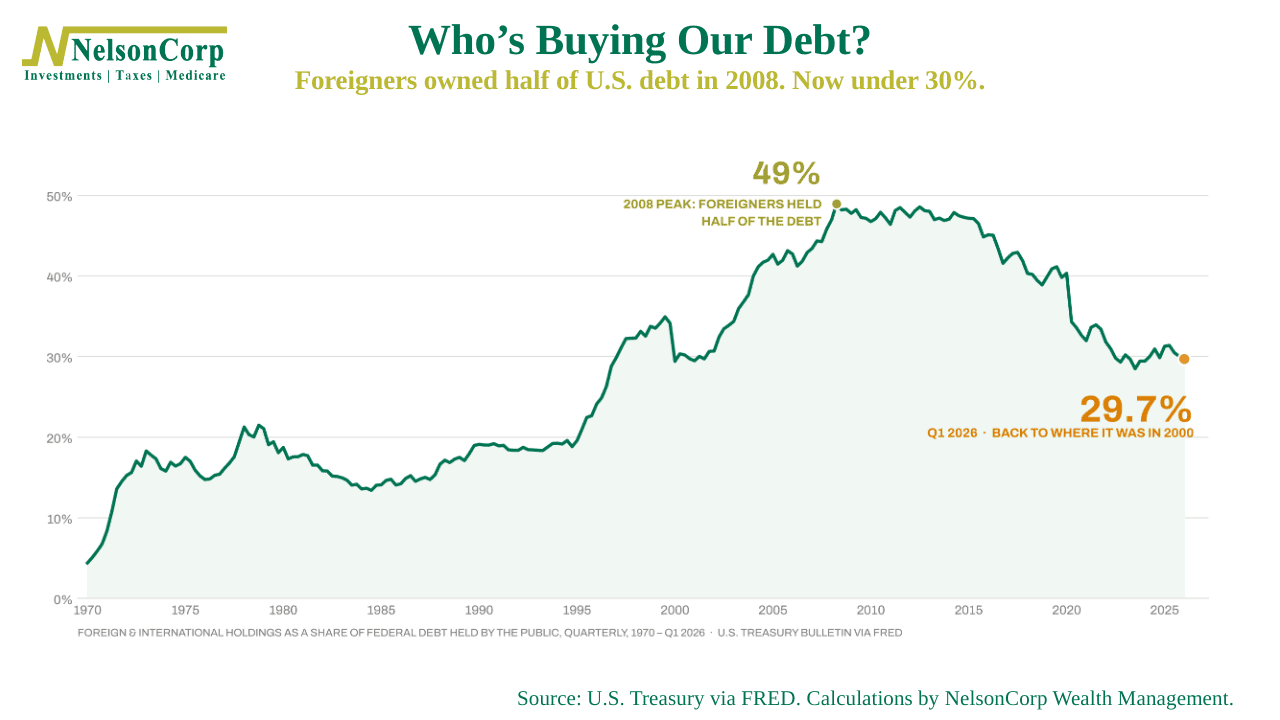
It shows the share of U.S. government debt owned by foreign investors, going back to 1970. Mostly, these are entities like foreign central banks, foreign banks, and overseas investors.
As you can see, in 1970 they owned about 4% of it. By 2008, they owned nearly half. But since then, the trend has run the other way. Today foreign investors hold just under 30% of the debt, about where they were in 2000.
But here’s the surprising part. Foreigners haven’t actually stopped buying. They own more Treasury bonds than ever, about $9.4 trillion. The problem is that Washington’s borrowing has grown much faster. Since the start of 2020, the debt held by investors is up 83%. Foreign holdings are up 35%.
So, who’s picking up the slack?
Investors here at home. Banks, money market funds, pension funds, insurance companies and, more and more, hedge funds. And those buyers are a bit pickier. A foreign central bank buys Treasuries to park its reserves—and doesn’t fuss much over price. A hedge fund, on the other hand, buys them to make money, and it wants a higher yield to do it.
That is one of the big reasons interest rates are where they are. The 10-year Treasury yield has been above 5% for a month now, and inflation is only part of the story. The government has more bonds to sell every year, and the buyers it is selling them to are driving a harder bargain.
The bottom line? The U.S. still has no trouble finding buyers for its debt. It just has to pay them more than it used to—and this will likely keep some upward pressure on bond yields.
This is intended for informational purposes only and should not be used as the primary basis for an investment decision. Consult an advisor for your personal situation.
Indices mentioned are unmanaged, do not incur fees, and cannot be invested into directly.
Past performance does not guarantee future results.