
Sometimes good investing comes down to spotting clues. And like a good detective, the most important clues are often not what something is doing, but what it isn’t doing.
That’s the idea behind this week’s indicator. In technical terms it’s called divergence, but the concept comes from one of the oldest principles in market analysis: Dow Theory.
More than a century ago, Charles Dow observed that the stock market tends to be healthiest when different parts of the economy are moving in the same direction. His reasoning was straightforward. If the economy is strong, companies should be producing goods and transportation companies should be shipping them. That means the Dow Jones Industrial Average and the Dow Jones Transportation Average should generally rise together during strong bull markets.
When they stop confirming each other, it can be a warning.
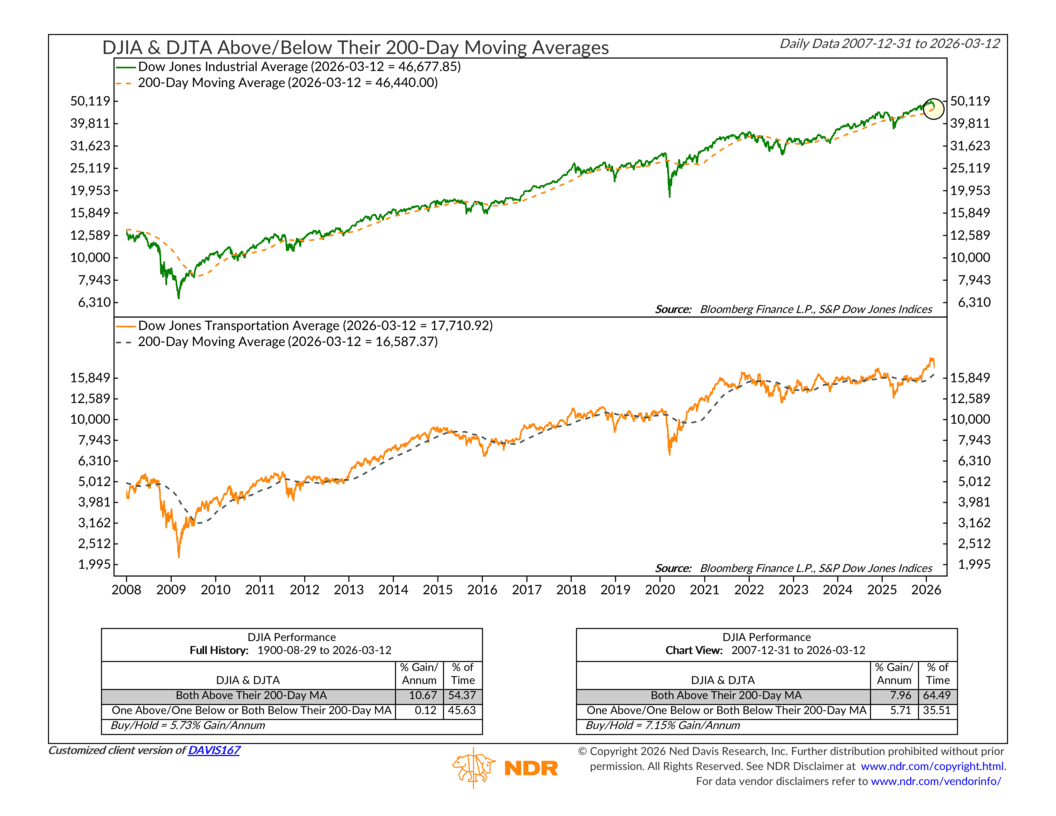
Our version of this idea simplifies things. Instead of focusing on new highs and lows, we look at whether each index is trading above or below its 200-day moving average, a widely used measure of the market’s long-term trend.
When both the Industrials and Transports are above their 200-day averages, the market is showing broad confirmation. Historically, that environment has been supportive for equities.
But when one or both indexes falls below that trend line, the bullish signal weakens. That kind of divergence suggests the market may be losing some of its internal support.
The numbers in the performance box tell the story. Since 2007, periods when both indexes were above their 200-day averages produced meaningfully stronger market returns than periods when that confirmation broke down. Simply put, stocks tend to do better when the economy’s producers and shippers are moving in sync.
So where do things stand today?
The Transportation Average has had a nice run to start the year, that’s for sure. But it is starting to roll over. And as for the Industrials, well, they are now slipping quickly toward their own 200-day moving average. If they break below that level, the indicator will flip into a divergence signal.
That doesn’t guarantee a market decline, but historically it has marked periods when the market environment is more fragile and returns are harder to come by.
In other words, it’s one more clue investors should keep an eye on as we move through the current market cycle.
This is intended for informational purposes only and should not be used as the primary basis for an investment decision. Consult an advisor for your personal situation.
Indices mentioned are unmanaged, do not incur fees, and cannot be invested into directly.
Past performance does not guarantee future results.
The Dow Jones Industrial Average (DJIA) is a price-weighted index composed of 30 widely traded blue-chip U.S. common stocks.
The Dow Jones Transportation Average is a 20-stock, price-weighted index that represents the stock performance of large, well-known U.S. companies within the transportation industry.