
The stock market runs on money. It prefers an environment in which liquidity is readily available and banks are flush with cash.
So naturally, we look to the nation’s central bank, the Federal Reserve, for clues on liquidity.
The Federal Reserve is primarily responsible for overseeing how much money flows through the economy. It does this via monetary policy.
When the Fed makes money easily accessible, we say it’s being “easy.” However, when it’s draining liquidity from the system, we say policy is “tight.”
One way to tell whether the Fed’s monetary policy is easy or tight is to follow the trend of free bank reserves.
What are free reserves? By law, most banks must keep a percentage of their deposits with the Fed.
But any amount they keep at the Fed over and above the required amount can be used to make investments.
We call these free reserves, and it’s usually a sign of easy monetary policy when banks as a whole have a larger number of free reserves.
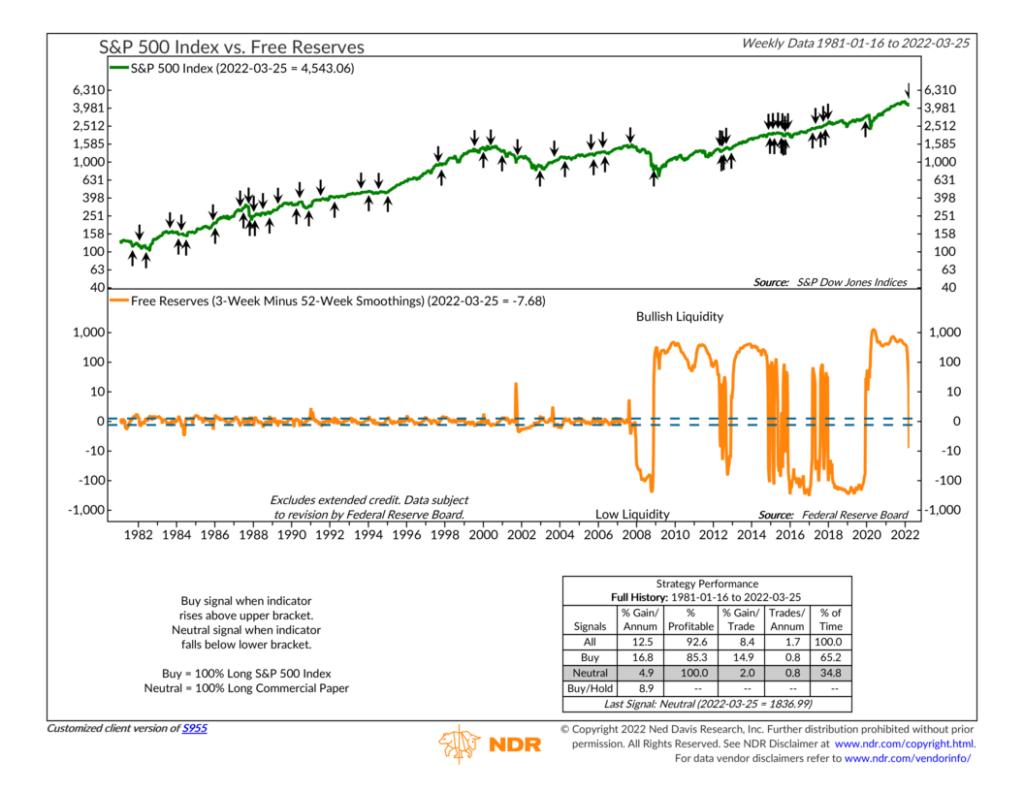
The bottom clip of the chart above shows the normalized level of free reserves (orange line) in the banking system. Normalized, in this case, means we take the 3-week average of reserves and subtract out the 52-week average.
When the line is rising—meaning free reserves are increasing at a faster pace—it’s a sign that the Fed is easing policy. Conversely, when the line is falling, the indicator suggests that the Fed is becoming increasingly tight or restrictive.
The historical performance of the S&P 500 (green line, top clip) corroborates the notion that higher levels of free reserves equate to better stock market returns and vice versa.
As a general rule, the market is in good shape when the normalized level of free reserves exceeds $200 million. But when it falls below -$180 million, it’s a sign that the market is in trouble.
One interesting thing to note about this chart is that you can see how much bigger the swings in normalized free reserves have become ever since the Great Financial Crisis in 2008. The Fed really ramped up its monetary policy in response to the crisis, and ever since, its influence on free bank reserves has become much larger than in the past.
Overall, though, the concept still holds. When free reserves are negative and falling—as they are now—it’s a sign that the Fed is stomping on the monetary policy brake. When they are positive and rising, however, the Fed is stepping on the accelerator.
This is intended for informational purposes only and should not be used as the primary basis for an investment decision. Consult an advisor for your personal situation.
Indices mentioned are unmanaged, do not incur fees, and cannot be invested into directly.
Past performance does not guarantee future results.