
The author Vaclav Smil once said that “Energy is the only universal currency.” He’s right. To take it a step further, you might even say that energy, in the form of oil, is the lifeblood of industrial civilization.
So, for this week’s indicator, let’s turn to oil. Sticking with our “universal currency” theme, I thought it would be interesting to look at how changes in oil prices have historically affected inflation. As you can probably guess, there’s a tight connection between the two.
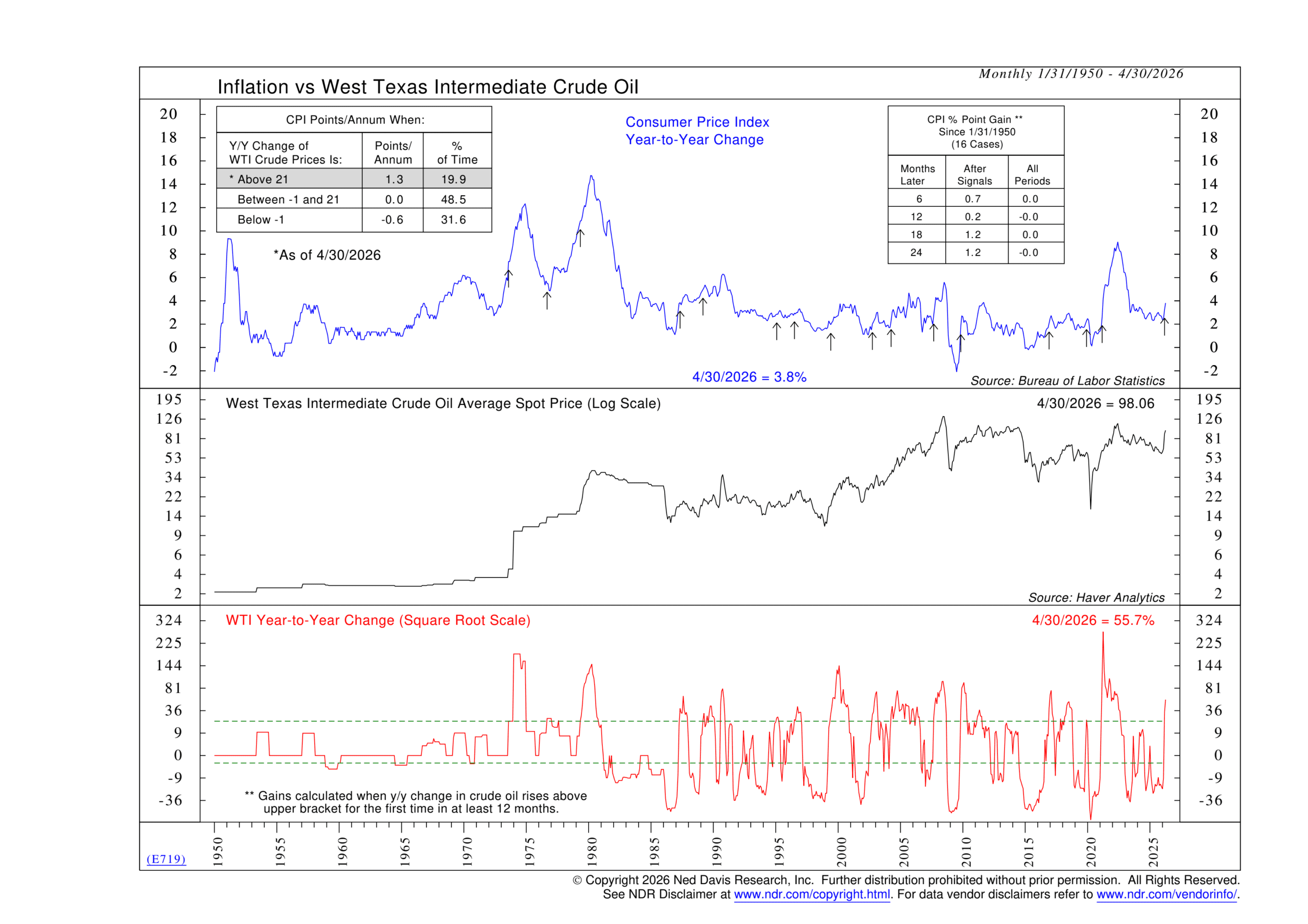
On the chart above, we have three sections. The top shows the year-to-year change in the Consumer Price Index (CPI), which measures inflation. In the middle, we have the spot price of West Texas Intermediate (WTI) crude oil, the benchmark for oil prices in the United States. In the bottom section, we have the year-to-year change in WTI oil prices.
The indicator works by looking at this bottom section, the year-to-year change in WTI oil, and determining whether it has risen above or fallen below the key parameters outlined by the green dashed lines. When the yearly change in oil exceeds 21% (the upper parameter), CPI inflation has historically shown significant increases. In contrast, inflation has tended to decline slightly when oil falls below the lower parameter.
Looking specifically at periods when oil prices are rising rapidly, the indicator finds that even 24 months after an oil spike, CPI can continue drifting higher by another percentage point or more.
This is a pretty significant finding given our current environment. As you can see in the bottom section, the year-over-year change in WTI oil was roughly 55% as of April 30. If history is any guide, this indicator suggests that inflation could remain elevated for longer than many investors expect. That is, to say the least, not ideal.
The takeaway? Oil is not the only thing that drives inflation. But history does show that it plays an important role. As investors, there are ways to navigate periods like this, but doing so requires staying flexible.
Overall, we would prefer to see oil prices come down from these elevated levels, as that would likely help bring headline inflation lower as well. Historically, that has been a much more favorable environment for stock ownership.
This is intended for informational purposes only and should not be used as the primary basis for an investment decision. Consult an advisor for your personal situation.
Indices mentioned are unmanaged, do not incur fees, and cannot be invested into directly.
Past performance does not guarantee future results.