
Hedge funds. You’ve probably heard of them before. But chances are you aren’t quite sure exactly what they do.
Don’t worry, not many people do. And that’s by design. On the surface, a hedge fund is simply a professionally managed pool of money for wealthy investors that uses aggressive or unorthodox investing strategies to earn higher returns. But their “secret sauce,” so to speak, is, well, a secret. It’s typically wrapped in a shroud of mystery and complicated mathematical strategies.
That’s why, traditionally, hedge funds have been known as the “smart money.”
But here’s the thing: hedge funds have become so numerous and large that they’ve actually become part of the investing “crowd,” albeit a special and important crowd. A more sophisticated crowd, if you will.
But remember, a core tenet of our investing philosophy is that, at extremes in sentiment, crowds are nearly always wrong. And that’s what our featured indicator this week focuses on: extremes in hedge fund sentiment.
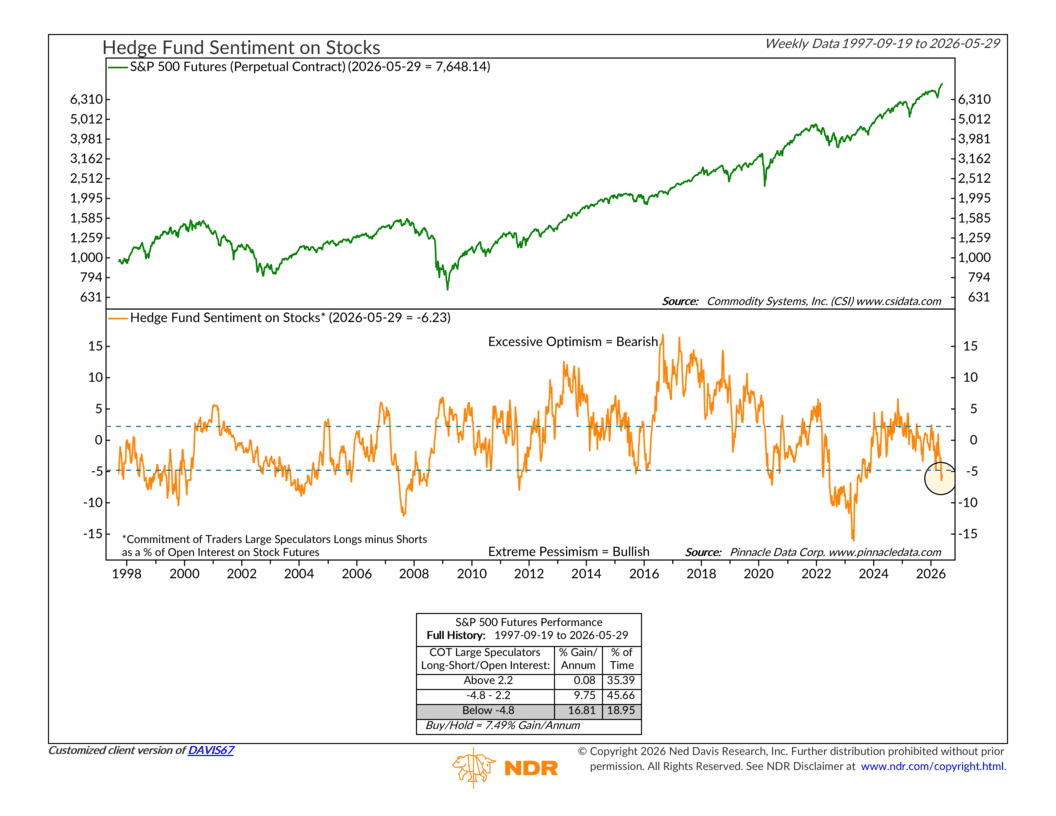
It does this via the Commitment of Traders data compiled by the Commodity Futures Trading Commission (CFTC). This data, shown as the orange line on the chart above, measures net long futures positions (in thousands of contracts) divided by total open interest for large speculators, or hedge funds.
Usually, large increases in speculators’ net long exposure are followed by market gains, while sharp declines in speculators’ positions often occur during flat or down markets. But at extremes, this changes. When the series climbs above the top bracket, it signals that large speculators are excessively optimistic. Historically, as the performance box at the bottom shows, this has actually led to very poor S&P 500 gains.
In other words, when the hedge funds go too far, it’s time to trim the hedges.
Conversely, when speculators’ positioning drops into the extreme pessimism zone (below the lower bracket), it’s a sign that the so-called smart money has become far too sour on the market. At that point, future stock market returns tend to improve dramatically.
That’s where we find ourselves today. After flopping around in the neutral zone for more than a year, hedge fund sentiment has now dipped into the lower pessimism zone. This is an important piece of counterevidence because, despite all the other warning signs of extreme investor optimism that we are seeing, this indicator is saying the opposite.
The bottom line? Historically, when hedge funds take substantial positions in the futures market, it generally pays to be wary. This chart highlights where these reversals occurred in the past and can therefore help anticipate shifts in investor psychology, and ultimately, stock prices.
This is intended for informational purposes only and should not be used as the primary basis for an investment decision. Consult an advisor for your personal situation.
Indices mentioned are unmanaged, do not incur fees, and cannot be invested into directly.
Past performance does not guarantee future results.
The S&P 500 Index, or Standard & Poor’s 500 Index, is a market-capitalization-weighted index of 500 leading publicly traded companies in the U.S.